The memory layer for LLM agents.
Local-first, importance-scored, auditable. Your agents keep what matters, on your infrastructure.

For the facts you can't afford to get wrong.
When your agent handles a prescription, a contract, or a portfolio, "probably remembered" isn't good enough. widemem gives health, legal, and financial facts higher importance floors, decay immunity, and forced contradiction detection.
widemem works for any app where memory matters, and it earns its keep wherever getting a fact wrong is expensive.
Context windows aren't memory.
Most memory systems treat every fact the same. Your user's blood type decays at the same rate as their lunch. Contradictions pile up silently. And recalling something from three months ago is a coin flip.
Nine things memory should do, and widemem does.
Each one earns its place. No feature theater.
Batch Conflict Resolution
One LLM call for N facts. Not N calls. Your wallet will thank you.
Importance + Decay
Facts rated 1-10. Old trivia fades. Critical facts don't.
Hierarchical Memory
Facts to summaries to themes. Broad questions get themes, specific ones get facts.
Active Retrieval
"Wait, you said San Francisco AND Boston?" Contradictions caught, not ignored.
Full Audit Trail
Every add, update, and delete logged to SQLite with timestamps.
YMYL Prioritization
Health, legal, financial facts get special treatment. Some things you just don't forget.
Uncertainty & Confidence
Knows when it doesn't know. Strict, helpful, or a clearly-flagged best guess.
Retrieval Modes
fast / balanced / deep. Choose your accuracy-cost tradeoff.
Memory Pinning
Pin a fact so it resists decay. For allergies, API keys, and the rule you refuse to explain again.
From raw conversation to ranked recall.
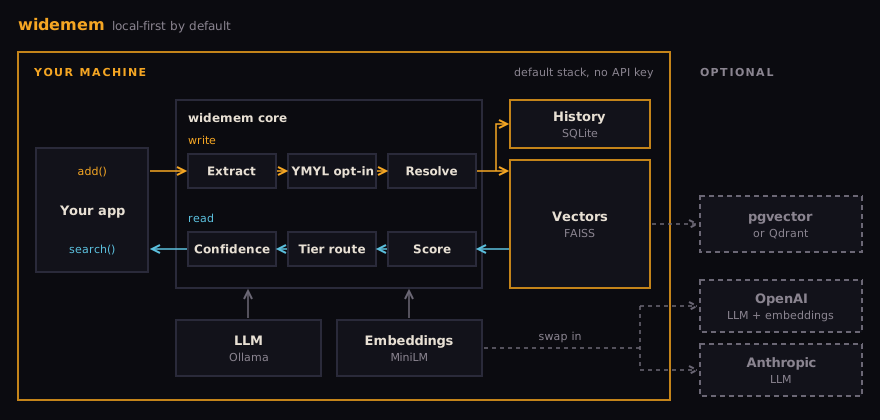
Pull facts from the conversation
Turn messy back-and-forth into discrete, storable facts.
Rate importance, flag YMYL
Each fact scored 1 to 10; health, legal, and financial content flagged for special handling.
Reconcile against what you already know
Every candidate checked against existing memory in a single LLM call, not one per fact.
Persist with a full audit trail
Written to SQLite with a timestamp on every add, update, and delete.
Return ranked, hierarchical recall
Facts, summaries, or themes, each with a confidence score, matched to the question.
Run it your way.
One library, four ways to run. Your data never has to leave.
Local-first
SQLite + FAISS, zero services. Nothing to stand up, nothing to page.
Self-hosted
Your VPC or Kubernetes. Data never leaves your perimeter.
Managed hosting
We run a dedicated deployment for you, on request.
Air-gapped
No egress, fully offline. For healthcare, finance, government, and any high-security environment.
One line to your first memory.
Pip is the fast path. uv, Docker, an MCP server, and source builds are all first-class.
Your data stays yours.
A library you run, not a black box you send secrets to.
<>Full audit trail
Every add, update, and delete is written to SQLite with timestamps. Reconstruct exactly what your agent knew and when.
[#]Self-hostable by default
Local-first and air-gap capable. Facts never have to touch a network you don't control.
(!)Vulnerability disclosure
A published security policy and a private channel for reports. We respond, patch, and credit.
{}Open source, Apache-2.0
Read the code that stores your users' facts. No hidden calls, no surprise egress.
widemem is a library you run, so your compliance boundary stays inside your own environment, backed by a full audit trail. For enterprise and regulated deployments that need certifications like SOC 2 or HIPAA, we can help you get there. Let's talk.
We publish our methodology and our corrections.
Benchmarks are only useful if you can check them. So we show ours.
We run LoCoMo openly. When we caught a scoring error in our own harness, we corrected it in public rather than quietly restating the number.
The current confirmed number is 55.15 overall J on the full v1.5 run, graded by an independent GPT-4o judge rather than our own harness. The methodology, the evaluation harness, and every correction are documented. Verify it yourself instead of taking a headline number on faith.
Ideas on memory worth reading.
Why memory is hard, and how widemem thinks about it.
The benchmark number we got wrong
A label transposition inflated our multi-hop score for four months. The correction, and the new independently judged numbers.
Read →ConceptsWhy context windows aren't memory
A bigger context window is not the same as remembering. Where the difference starts to bite.
Read →YMYLTelling a river bank from a savings account
How semantic YMYL classification decides which facts get the careful treatment.
Read →UncertaintyYour AI should know when it doesn't know
Confidence, abstention, and why guessing is the wrong default for memory.
Read →CostWhat memory actually costs
The real price of remembering, and how batching conflict resolution keeps it down.
Read →ConflictsWhen your agent remembers two contradictory things
Detecting and resolving contradictions instead of silently stacking them up.
Read →AuditWhat audit-grade memory looks like
Timestamped, reconstructable history, so you can answer who knew what and when.
Read →